

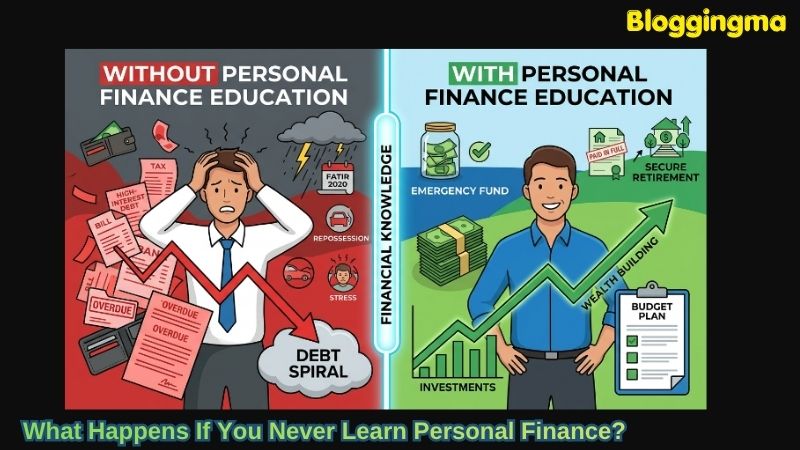
Nobody fails at money on purpose. Most people who end up broke, buried in debt, or reaching retirement with almost nothing saved did not make one catastrophic decision. They made hundreds of small ones — month after month — without ever understanding the system they were operating in. That is what financial ignorance actually looks like in practice. Not a dramatic crash. A slow, quiet drift toward outcomes that could have been avoided entirely with knowledge that takes weeks, not years, to build.
The numbers in 2026 make this impossible to ignore. Poor financial literacy cost Americans more than $246 billion in 2026. That is not a rounding error. That is the measurable price of not knowing how money works — paid in interest charges, missed investment returns, avoidable fees, and retirement accounts that never got started. If you have ever wondered what actually happens when someone goes through life without learning personal finance, the answer is specific, documented, and worth taking seriously.
You Stay Stuck in the Paycheck-to-Paycheck Cycle
The most immediate consequence of never learning personal finance is the trap that catches the largest number of people — living paycheck to paycheck with no financial buffer between your current life and a crisis.
Only 30% of Americans would use savings to cover a major unexpected expense of $1,000. That means seven out of ten people are one car repair, one medical bill, or one missed shift away from financial stress. This is not a poverty issue alone. It happens across income levels, because the problem is not the size of the paycheck — it is the absence of any system to manage it.
When you never learn how to allocate income deliberately, spending fills the available space. Subscriptions accumulate. Lifestyle inflates with every raise. The gap between income and savings never closes because there is no plan to close it. The result is that millions of people earn more than their parents did, live more comfortably on the surface, and end up with less financial security because they never learned what to do with the difference. Our guide on how to save money from salary covers exactly how to break this cycle — but the first step is understanding why the cycle exists in the first place.
Debt Becomes Your Default Financial Tool
People who never learn personal finance do not avoid debt — they use it incorrectly. Not because they are careless, but because nobody explained the difference between debt that builds toward something and debt that simply costs money indefinitely.
Average consumer debt reached $104,755 as of mid-2025, and total US household debt hit $18.59 trillion in September 2025. These are not numbers driven by emergencies alone. A significant portion represents consumer spending financed at high interest rates — credit card balances carried month to month, buy-now-pay-later obligations stacked on top of each other, personal loans taken out to cover the gap that better money habits would have prevented.
Adults with very low financial literacy are twice as likely to be debt-constrained. The mechanism is straightforward: without understanding how compound interest works against you as a borrower, it is easy to underestimate the real cost of carrying a balance. A $5,000 credit card balance at 24% APR costs $1,200 in interest per year — but that number does not feel real when you are only looking at the minimum payment on a statement.
The 2026 annual financial literacy report found that five areas fell — consuming, borrowing, earning, insuring, and comprehending risk. Borrowing is specifically one of the areas where financial knowledge is weakest and declining. That is the exact area where ignorance costs the most in real dollars.

Your Retirement Gets Sacrificed Without You Noticing
Retirement is the longest-term consequence of financial ignorance — and the one that is hardest to reverse once time has passed.
About 36% of Americans had less than $10,000 saved for retirement, while only 13% reported being ahead of their retirement goals. These numbers reflect what happens when compound interest is never understood or used intentionally. The people with the least saved are almost always those who started latest — not because they lacked income, but because nobody explained that starting at 25 versus 35 is not a ten-year difference. It is a difference of hundreds of thousands of dollars due to compounding.
Consider two people earning identical salaries. One starts contributing $300 per month to a retirement account at age 25. The other starts at 35. By retirement at 65, the first person has contributed for 40 years and the second for 30. Assuming a 7% average annual return, the first person retires with roughly $750,000. The second retires with approximately $340,000 — less than half — despite only a ten-year difference in start date. That gap is not income. It is knowledge about how time and compounding work together.
Only 31% of US households had a documented, long-term financial plan in 2025. The majority of people reach retirement age without ever having written down what they needed, what they had, or how to close the gap. The consequences of that absence show up not in their bank accounts during their working years, but in the retirement they actually get to live.
Financial Stress Becomes a Permanent Condition
The consequences of financial ignorance are not only mathematical. They are psychological — and the psychological cost is one that bleeds into every other area of life.
More than half of consumers — 57% — are negatively impacted by financial stress, with rates highest among Gen Z at 71%. Financial stress correlates with worse health outcomes, more relationship conflict, reduced workplace performance, and lower overall life satisfaction. This is not a coincidence. When the foundation of daily life — the ability to pay for housing, food, healthcare, and emergencies — feels uncertain, the cognitive load is enormous and constant.
What most people do not realize is that this stress is not an inevitable result of having limited income. It is largely a result of operating without a system. People who earn modest incomes but have a functioning financial plan — a budget that reflects their actual spending, a small emergency fund, a clear picture of their debt — consistently report significantly less financial stress than higher earners who have never built that structure. The knowledge is what creates the stability, not the income level alone.
Wealth Never Builds — It Just Gets Spent
One of the quietest consequences of never learning personal finance is that income becomes purely consumable. Money comes in and goes out, and nothing accumulates on the other side of the equation.
The top 1% of Americans held 31.7% of total household wealth in Q3 2025 — the widest concentration in three decades. That concentration does not happen only because of income differences. It accelerates because of knowledge differences. People who understand investing, tax-advantaged accounts, asset allocation, and compounding grow wealth continuously. People who do not earn income that gets spent and save nothing — even when they earn reasonable salaries.
In January 2026, Americans saved just 4.5% of their income on average. The recommended minimum for building genuine financial security is 15% to 20%. The gap between what people save and what they should save is not a gap in desire — most people want to save more. It is a gap in system. Nobody showed them how to make saving automatic, how to build a budget that actually works, or how to resist the lifestyle inflation that consumes every raise before it can be redirected toward the future.
Learning even the basics — the 50/30/20 rule, the concept of paying yourself first, what a high-yield savings account is — changes the trajectory significantly. Our best salary saving rule guide covers exactly these foundations. The knowledge is not complex. But without it, wealth simply never accumulates regardless of how much passes through your hands.
You Wish You Had Learned It Sooner
Perhaps the most telling data point in all the financial literacy research is this one: 82% of adults who attended high school wish they had been required to take a personal finance class.
Eight out of ten people, looking back on their education, identify personal finance as the subject they most needed and did not get. That is not a small regret. That is a near-universal recognition that the knowledge gap had real consequences — consequences most of them are still managing decades later.
33% of Americans have no financial plan of any kind, while 36% have thought about their goals but never documented them. Among those without a plan, 43% say it is because they do not have enough money to make planning worthwhile. That belief — that financial planning is something you do after you have money — is itself a product of financial ignorance. Planning is what creates the conditions for having money. The direction runs the opposite way to what most people assume.
The Good News — It Is Never Too Late to Start
The consequences of financial ignorance are real and significant. But none of them are permanent for someone who decides to start learning now. The people who turned their financial situation around are not exceptional. They are ordinary people who got hold of a few specific ideas and applied them consistently.
The foundational ideas are not complicated. Spend less than you earn. Save a fixed percentage before spending anything else. Build an emergency fund before investing. Understand the difference between good debt and expensive debt. Start retirement contributions as early as possible and never stop.
Only 31% of US households have a documented financial plan. Which means that simply writing down your income, your expenses, your savings target, and your debt payoff timeline already puts you ahead of the majority. That is not a high bar. It is just a bar that most people have never been shown how to clear.
Start with how to start saving from zero if you are building from scratch. Work through 20 smart ways to save money fast to find the specific tactics that fit your life. And use the 30-day money saving challenge to build momentum within a single month. The knowledge exists. The tools are free. The only thing that was missing was a reason to start — and now you have one.
Frequently Asked Questions
What are the real consequences of financial illiteracy? The consequences include carrying high-interest debt longer than necessary, failing to build retirement savings, living paycheck to paycheck without a buffer for emergencies, and accumulating wealth far more slowly than income would allow. Poor financial literacy cost Americans more than $246 billion in 2025 alone — measured in avoidable fees, interest charges, and missed investment returns.
Does financial illiteracy affect mental health? Yes, directly. More than 57% of consumers report being negatively impacted by financial stress in 2025, with Gen Z reaching 71%. Financial stress correlates with anxiety, reduced sleep quality, relationship conflict, and lower workplace performance. Learning personal finance reduces stress not by increasing income but by creating a functional system for managing whatever income exists.
Is it too late to learn personal finance as an adult? No. The foundational concepts of personal finance — budgeting, emergency funds, debt payoff methods, compound interest, and retirement contributions — can be learned and applied at any age. The earlier you start, the more compounding works in your favor. But starting at 40 or 50 still produces meaningfully better outcomes than never starting at all.
Why do so many people never learn personal finance? Primarily because it is not taught in most schools. Only 45% of high schoolers took any personal finance class in 2025, and 82% of adults who attended high school wish they had been required to. Most people inherit their financial habits from their parents — and if those habits were not built on strong financial knowledge, the gap passes from generation to generation.
What is the first step to learning personal finance? Start with one concept at a time. Understanding how to budget — allocating income before you spend it rather than tracking what you have already spent — is the highest-leverage first step for most people. The 50/30/20 rule is the simplest framework to start with. From there, building a starter emergency fund of $500 to $1,000 protects the budget from being disrupted by unexpected expenses.
The Cost of Not Knowing Is Higher Than the Cost of Learning
Never learning personal finance is not a neutral decision. It has a price — paid in interest, in stress, in retirement savings that never grew, and in wealth that passed through your hands without leaving anything behind.
The good news is that the knowledge itself is accessible, free, and faster to build than most people expect. A few hours spent understanding how budgeting, saving, debt, and investing actually work produces returns that compound for the rest of your life. Start with what matters most for your specific situation right now — and let the knowledge do the rest.
Read Also: 30-Day Money Saving Challenge (Step-by-Step Guide to Save Money Fast)
Read Also: Best Daily Saving Habits (Complete Guide to Build Wealth Step by Step)
Read Also: 12 Clever Way to Save Money Fast: Practical Tips That Actually Work
Read Also: The Ultimate Guide to Saving Money: Personal Finance Tips That Actually Work