

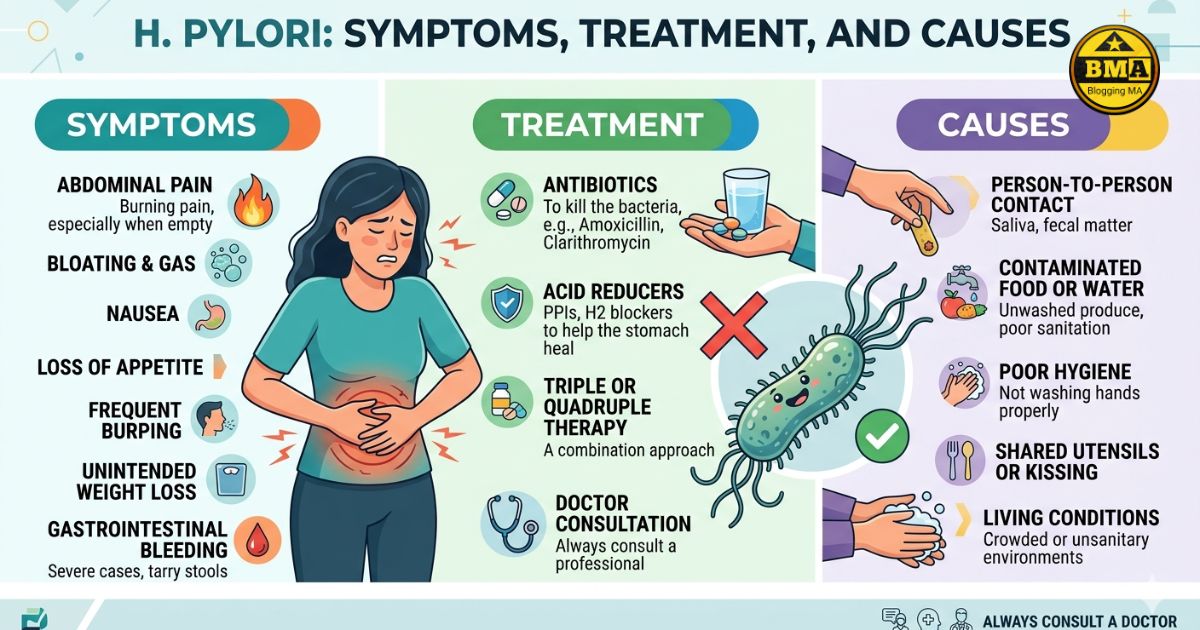
H. Pylori Symptoms & Treatment Guide
Helicobacter pylori infection is a common digestive issue that affects millions of people worldwide. Many individuals do not notice symptoms at first, but over time, it can cause serious stomach problems. Understanding h pylori symptoms is important for early diagnosis and proper treatment.
Common signs include stomach pain, bloating, nausea, and loss of appetite. If ignored, the infection may lead to ulcers or other complications. Learning about digestive issues linked to this bacteria helps you take preventive steps. Early recognition of h pylori symptoms can help you seek medical advice and avoid long-term health risks.
H Pylori Symptoms
Most people don’t feel symptoms, but when they do, common signs include:
- Burning pain in the stomach (especially when empty)
- Bloating and excessive burping
- Nausea or vomiting
- Loss of appetite
- Unexplained weight loss
- Dark or black stools (in severe cases)
If symptoms get worse, it may lead to peptic ulcers or irritation of the stomach lining.
Causes & Spread
Helicobacter pylori spreads through contaminated food, water, or close contact. Poor hygiene and unsafe drinking water increase the risk.
Realted Article : The Psychology of People Who Go Silent When They’re Hurt (Advanced Guide )
Treatment
The main goal is to kill the bacteria and reduce stomach acid. Doctors usually prescribe a combination of medicines:
- Antibiotics (to kill bacteria):
- Amoxicillin
- Clarithromycin
- Metronidazole
- Proton Pump Inhibitors (PPIs) (to reduce acid):
- Omeprazole
- Lansoprazole
- Sometimes bismuth-containing medicines are added to protect the stomach lining.
This combination is often called triple therapy or quadruple therapy and is usually taken for 10–14 days.
Important Tips
- Always complete the full course of medication
- Avoid spicy, oily, and acidic foods during treatment
- Do not smoke or drink alcohol
- Wash hands properly and use clean water
When to See a Doctor
Seek medical help if you have severe stomach pain, vomiting blood, or black stools. These may indicate complications.
Proper treatment can completely cure Helicobacter pylori infection, but early diagnosis is important to avoid long-term problems like ulcers.
Helicobacter pylori (H. pylori) infection
- Symptoms &
causes - Diagnosis &
treatment - Doctors &
departments
Diagnosis
Several tests and procedures are used to determine whether you have Helicobacter pylori (H. pylori) infection. Testing is important for detection of Helicobacter pylori (H. pylori). Repeat testing after treatment is important to be sure H. pylori is gone. Tests may be done using a stool sample, through a breath test and by an upper endoscopy exam. What is Helicobacter pylori (H. pylori)? H pylori test.
Related Article Read Also : The 5-Minute Mental Reset That Actually Works (Guide to Instant Focus & Calm)
| what are the first symptoms of h pylori? |
Stool tests
- Stool antigen test. This is the most common stool test to detect H. pylori. The test looks for proteins (antigens) associated with H. pylori infection in the stool.
- Stool PCR test. A lab test called a stool polymerase chain reaction (PCR) test can detect H. pylori infection in stool. The test can also identify mutations that may be resistant to antibiotics used to treat H. pylori. However, this test is more expensive than a stool antigen test and may not be available at all medical centers.
Breath test
During a breath test — called a urea breath test — you swallow a pill, liquid or pudding that contains tagged carbon molecules. If you have H. pylori infection, carbon is released when the solution comes in contact with H. pylori in your stomach.
Because your body absorbs the carbon, it is released when you breathe out. To measure the release of carbon, you blow into a bag. A special device detects the carbon molecules. This test can be used for adults and for children over 6 years old who are able to cooperate with the test.
Scope test
A health care provider may conduct a scope test, known as an upper endoscopy exam. Your provider may perform this test to investigate symptoms that may be caused by conditions such as a peptic ulcer or gastritis that may be due to H. pylori.
For this exam, you’ll be given medication to help you relax. During the exam, your health care provider threads a long, flexible tube with a tiny camera (endoscope) attached down your throat and esophagus and into your stomach and the first part of the intestine (duodenum). This instrument allows your provider to view any problems in your upper digestive tract. Your provider may also take tissue samples (biopsy). These samples are examined for H. pylori infection.
Because this test is more invasive than a breath or stool test, it’s typically done to diagnose other digestive problems along with H. pylori infection. Health care providers may use this test for additional testing and to look for other digestive conditions. They may also use this test to determine exactly which antibiotic may be best to treat H. pylori infection, especially if the first antibiotics tried didn’t get rid of the infection.
This test may be repeated after treatment, depending on what is found at the first endoscopy or if symptoms continue after H. pylori infection treatment.
Testing considerations
Antibiotics can interfere with the accuracy of testing. In general, retesting is done only after antibiotics have been stopped for four weeks, if possible.
what are the first symptoms of h pylori?
Acid-suppressing drugs known as proton pump inhibitors (PPIs) and bismuth subsalicylate (Pepto-Bismol) can also interfere with the accuracy of these tests. It’s possible acid-suppressing drugs known as histamine (H-2) blockers may also interfere with the accuracy of these tests. Depending on what medications you’re taking, you’ll need to stop taking them, if possible, for up to two weeks before the test. Your health care provider will give you specific instructions about your medications.
The same tests used for diagnosis can be used to tell if H. pylori infection is gone. If you were previously diagnosed with H. pylori infection, you’ll generally wait at least four weeks after you complete your antibiotic treatment to repeat these tests.
More Information
- Upper endoscopy
Treatment
H. pylori infections are usually treated with at least two different antibiotics at once. This helps prevent the bacteria from developing a resistance to one particular antibiotic.
Treatment may also include medications to help your stomach heal, including:
- Proton pump inhibitors (PPIs). These drugs stop acid from being produced in the stomach. Some examples of proton pump inhibitors (PPIs) are omeprazole (Prilosec), esomeprazole (Nexium), lansoprazole (Prevacid) and pantoprazole (Protonix).
- Bismuth subsalicylate. More commonly known by the brand name Pepto-Bismol, this drug works by coating the ulcer and protecting it from stomach acid.
- Histamine (H-2) blockers. These medications block a substance called histamine, which triggers acid production. One example is cimetidine (Tagamet HB). histamine (H-2) blockers are only prescribed for H. pylori infection if PPIs can’t be used.
Repeat testing for H. pylori at least four weeks after your treatment is recommended. If the tests show the treatment didn’t get rid of the infection, you may need more treatment with a different combination of antibiotics.