

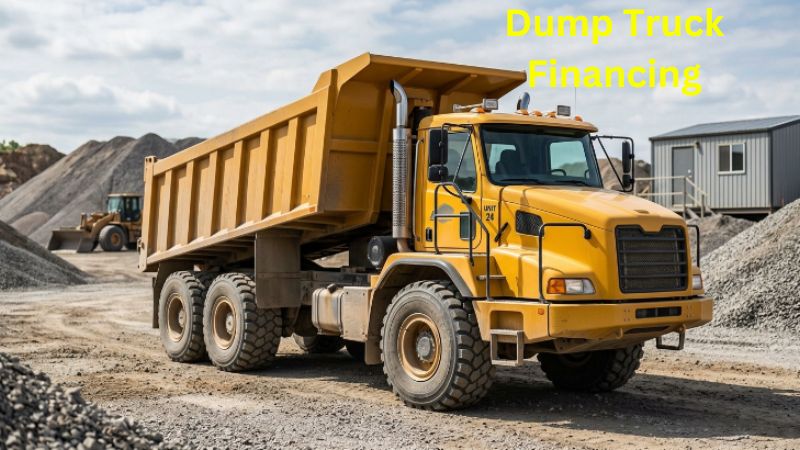
A dump truck is not a purchase — it is a business investment. Whether you are starting a hauling operation from scratch, adding a second truck to an existing fleet, or replacing aging equipment that is costing more in repairs than it is worth keeping, the decision to acquire a dump truck is fundamentally a cash flow decision. The question is never really “can I afford this truck?” The real question is: “Does financing this truck generate more income than it costs to finance?”
For most operators who have done the math honestly, the answer is yes — by a significant margin. A single dump truck generating $1,800 to $3,500 per week in hauling revenue can cover its own financing payment multiple times over. The challenge is getting the financing structure right — the right loan amount, the right term, the right rate — so the monthly obligation fits within your business cash flow from day one. This guide covers every dump truck financing option available in 2026, what the real rates look like, how to qualify, and how to choose the structure that makes the most financial sense for your operation.
Dump Truck Financing Calculator
Dump Truck Financing Calculator
Calculate your monthly payment, total interest, and full repayment cost
[CALLOUT BOX — WHAT YOU WILL LEARN]
- How much a dump truck costs in 2026 — new vs used
- Every financing option explained — loans, leases, SBA, and equipment financing
- What rates qualified borrowers are actually getting right now
- How Section 179 tax deductions change the real cost of ownership
- What credit score and business history lenders require
- The one calculation every operator must run before signing a financing agreement
How Much Does a Dump Truck Cost in 2026?
Before comparing dump truck financing options, you need to know what you are actually financing. Dump truck costs vary significantly based on the type of truck, its payload capacity, whether it is new or used, and the configuration needed for your specific hauling work.
A new single-axle dump truck — the most common entry-level commercial unit — typically runs between $100,000 and $150,000. A new tandem-axle dump truck with higher payload capacity generally costs between $130,000 and $180,000. Heavy-duty tri-axle and quad-axle units used for large construction and infrastructure projects can exceed $200,000 to $250,000 new from major manufacturers including Mack, Kenworth, Peterbilt, and International.
Used dump trucks offer significantly lower entry costs. A used single-axle truck in good working condition typically runs between $30,000 and $80,000 depending on age, mileage, and maintenance history. A quality used tandem-axle truck generally falls in the $50,000 to $120,000 range. Interest rates on used commercial vehicles have stabilized in 2026, with qualified borrowers accessing rates between 6.5% and 9.5% depending on creditworthiness and loan structure.
These figures explain why dump truck financing is not just common — it is essentially universal for independent operators and small fleet owners. Almost nobody pays cash for a commercial dump truck. The financing structure determines how much the truck actually costs over its useful life, and choosing the right structure from the start can save an operator $8,000 to $25,000 over a typical loan term.
The 2026 Dump Truck Financing Landscape — What Rates Look Like Right Now
Before diving into specific financing options, it helps to know exactly where the market stands in 2026. Here is what the current 2026 financing landscape actually looks like for most business owners: Loan amounts typically range from $25,000 to $250,000 or more, depending on the truck and your file strength. Repayment terms generally run 24 to 60 months, with some manufacturer-backed programs extending up to 66 months on select pre-owned units. Interest rates for prime borrowers with credit of 650 or above and two or more years in business generally fall in the 7% to 14% range. Subprime borrowers often see 15% to 30%. Down payments typically fall between 10% and 20%, though some strong files can qualify for zero down, and weaker credit profiles may need 30% or more.
These numbers tell you several important things before you apply for anything. First, your credit score and business history matter enormously — the gap between a 7% rate and a 20% rate on a $80,000 truck loan over 48 months is over $30,000 in total interest. Second, a down payment reduces your loan amount and often improves your rate tier — so even a 10% down payment on a $60,000 used truck ($6,000) can shift you into a more favorable rate category. Third, two or more years of documented business history is a threshold that opens significantly better financing options than being brand new to the industry.
5 Dump Truck Financing Options — Compared Clearly
1. Equipment Financing Loans
Equipment financing is the most commonly used structure for dump truck acquisition. The truck itself serves as collateral for the loan — which means the lender has a secured interest in the vehicle, reducing their risk and typically producing better rates than unsecured business loans.
With an equipment financing loan, you own the truck from day one. You build equity in the asset with every payment, can operate it as many hours as your business demands without mileage restrictions, and capture the full tax benefit of ownership through Section 179 expensing or bonus depreciation. At the end of the loan term, you own the truck outright — an asset with real resale value.
Equipment financing lenders for dump trucks include commercial banks, credit unions, specialty commercial vehicle lenders like Liberty Capital Group, and online business lenders. Approval is based on your business credit score, time in business, annual revenue, and the value of the truck itself as collateral. Most lenders want to see at least one to two years of business history and a credit score above 600 for standard approval.
2. Equipment Leasing
Leasing remains the preferred choice for operators who prioritize cash flow management and equipment flexibility. Under a lease arrangement, you gain full operational use of the dump truck while the financing company retains ownership. Monthly payments are typically lower than loan payments, and at lease end, you have options to purchase, return, or upgrade to newer equipment.
A lease structure makes sense in specific situations. If your business is seasonal and cash flow is uneven across the year, lower lease payments reduce financial pressure during slow months. If you want to upgrade to newer equipment every three to five years without dealing with the sale of old equipment, a lease provides a clean exit. And if your business needs change — you expand into a different type of hauling that requires a different truck configuration — a lease gives you flexibility that ownership does not.
The trade-off is that you do not build equity in the leased truck, you may face mileage or usage restrictions depending on the lease terms, and the total cost of leasing over multiple cycles typically exceeds the cost of owning the same equipment over the same period. The tax implications of leasing deserve careful consideration. Lease payments are generally fully deductible as a business expense, which can significantly reduce your tax burden compared to the depreciation schedules associated with owned assets.
3. SBA Loans for Commercial Trucks
The Small Business Administration’s 7(a) loan program can be applied to commercial vehicle purchases including dump trucks. SBA 7(a) loans offer amounts up to $5,000,000, repayment terms up to 10 years for equipment, and interest rates that are among the lowest available for small business financing — typically prime rate plus 2.75% to 4.75%, which in the current market puts rates in the 7% to 11% range for qualified borrowers.
The SBA loan process is more involved than equipment financing — it requires more documentation, takes longer to process, and involves additional fees. For operators who qualify, however, the rate advantage and longer available terms can make a meaningful difference on larger truck purchases. The US Small Business Administration provides full eligibility requirements and lender directories for both the 7(a) and 504 loan programs, which can both be applied to commercial vehicle acquisition.
4. Commercial Line of Credit
A commercial line of credit from a bank or credit union provides revolving access to funds that can be drawn as needed — including for vehicle acquisition. Unlike a term loan where you receive a fixed amount at closing, a line of credit lets you draw what you need when you need it and repay at your own pace within the credit limit.
Lines of credit are most useful for operators who are buying used trucks at auction, where deals move fast and having pre-approved financing ready to deploy immediately is a competitive advantage. They also work well for businesses that need flexible capital across multiple purposes — truck purchase, equipment upgrades, working capital — rather than a single dedicated loan.
The limitation is that lines of credit typically carry variable interest rates and may have lower credit limits than dedicated equipment financing. For a single defined truck purchase, a fixed-rate equipment loan usually produces a better total cost outcome.
5. Manufacturer and Dealer Financing
Major dump truck manufacturers and their dealer networks offer financing directly through the purchase process — often with competitive promotional rates on new equipment to incentivize sales. Manufacturer financing programs from Mack Financial Services, Kenworth Financial, and similar programs are designed specifically for commercial truck buyers and can offer terms tailored to commercial vehicle economics including seasonal payment structures and deferred payment start dates.
The convenience of dealer financing is real — everything happens in one place at the point of purchase. But as with any financing offered at point of sale, the rate offered is not always the most competitive available. Always get at least one outside quote before accepting any dealer financing offer. Even a 1% to 2% rate difference on a $100,000 truck loan over 60 months saves $2,500 to $5,000 in total interest.
Section 179 Tax Deduction — How It Changes the Real Cost of Dump Truck Ownership
This is one of the most important financial concepts for any dump truck buyer to understand — and one of the most frequently overlooked. Section 179 of the US tax code allows businesses to deduct the full purchase price of qualifying equipment — including dump trucks — in the year of purchase rather than depreciating the asset over its useful life.
For 2026, the Section 179 deduction limit is $1,160,000 for qualifying equipment purchases. A business that purchases a $90,000 dump truck and has sufficient taxable income can deduct the full $90,000 in the year of purchase — potentially saving $22,500 to $31,500 in federal taxes at the 25% to 35% business tax rate. Bonus depreciation provisions may allow additional deductions beyond the Section 179 limit for qualifying assets.
Having the best access to dump truck financing rates can generate your business income, conserve cash flow, and receive 100% tax benefits with Section 179 or bonus depreciation.
This tax benefit fundamentally changes the real cost of dump truck ownership. A $90,000 truck that generates a $25,000 tax saving in Year 1 has an effective net cost of $65,000 — before any income the truck generates. Running this calculation before you choose between leasing and buying often makes ownership through financing the clear winner for operators with sufficient taxable income.
Consult a business tax professional before making any purchasing decision based on Section 179 — the deduction has specific eligibility requirements and phase-out provisions that vary by business situation.
A Real Example: How Marcus Financed His First Dump Truck
Marcus, 36, started a small hauling business after spending eight years working for a construction company. He had $18,000 in savings, strong knowledge of the industry, and a verbal commitment from a local contractor for regular hauling work.
His target truck: A 2019 Kenworth T440 tandem-axle dump truck listed at $72,000 from a commercial dealer.
Financing options he compared:
- Dealer financing: 11.5% APR, 60 months — monthly payment $1,577, total interest $22,620
- Equipment lender (Liberty Capital): 9.2% APR, 60 months — monthly payment $1,498, total interest $17,880
- Credit union equipment loan: 8.1% APR, 60 months — monthly payment $1,461, total interest $15,660
Down payment: $12,000 — reducing financed amount to $60,000 and improving his rate tier.
What he chose: Credit union equipment loan at 8.1% APR. Monthly payment of $1,461 against projected revenue of $6,500 to $8,000 per month from the contractor commitment.
Section 179 benefit: At a 25% effective tax rate, deducting $72,000 in Year 1 saved approximately $18,000 in federal taxes — reducing his effective net acquisition cost to $54,000.
Result: After 14 months of consistent hauling contracts, Marcus added a second truck financed on the strength of his established business history and two years of tax returns showing consistent revenue. His first financing decision — choosing the credit union loan and making the $12,000 down payment — gave him the rate and payment structure that made the business profitable from month one.
What Credit Score and Business History Do You Need?
Interest rates for prime borrowers with credit of 650 or above and two or more years in business generally fall in the 7% to 14% range. Subprime borrowers often see 15% to 30%. Bad credit programs for scores below 625 usually cap the financed amount at $45,000, require a minimum of 50% down, and carry rates in the 15% to 30% range.
| Credit Score | Time in Business | Typical APR | Down Payment Required |
| 720+ | 2+ years | 6.5% to 9% | 10% to 15% |
| 680 to 719 | 2+ years | 8% to 12% | 10% to 20% |
| 650 to 679 | 1 to 2 years | 10% to 15% | 15% to 25% |
| 625 to 649 | 1+ year | 13% to 20% | 20% to 30% |
| Below 625 | Any | 15% to 30% | 30% to 50% |
| New business | Less than 1 year | 12% to 25% | 20% to 35% |
For operators with limited credit history or a new business, two strategies significantly improve financing access. First, a larger down payment — even 20% to 25% instead of the minimum 10% — reduces lender risk and often moves an application into a better rate tier. Second, providing strong documentation of signed hauling contracts or letters of intent from clients gives lenders confidence in your revenue projections even without a long business track record.
Building strong financial habits alongside a new business — consistent saving, controlled expenses, and avoiding unnecessary debt — is what creates the financial profile that lenders reward with competitive rates. The principles in our best daily saving habits guide and how to save money from salary apply directly to business owners managing cash flow alongside financing obligations.
Common Mistakes Operators Make With Dump Truck Financing
| Mistake | Why It Fails | What To Do Instead |
| Accepting the first financing offer | First offers are rarely the most competitive — especially at dealerships | Compare at least three lenders before accepting any offer |
| Choosing the longest term to minimize monthly payment | Longer term significantly increases total interest paid | Calculate total repayment across 36, 48, and 60 month terms before choosing |
| Not factoring Section 179 into the buy vs lease decision | Ownership tax benefits can reduce effective acquisition cost by 25% to 35% | Run the Section 179 calculation with your accountant before choosing lease or loan |
| Financing a truck without confirmed revenue | Truck payment without secured work creates immediate cash flow pressure | Secure at least one contract or LOI before committing to any financing obligation |
| Ignoring used truck financing | New truck financing at higher amounts costs more than quality used at lower rates | A well-maintained 3 to 5 year old truck at 40% to 60% of new price often delivers better ROI |
[CALLOUT BOX — PRO TIP] Before applying for dump truck financing, ask your accountant one question: “If I purchase this truck this year, what is my estimated Section 179 deduction and the resulting tax saving?” That number changes the real cost of ownership dramatically — and often makes buying through financing significantly more attractive than leasing when the tax math is included. Run the after-tax numbers before making any structure decision.
[CALLOUT BOX — WARNING] Be cautious of any dump truck financing offer that does not disclose the full APR in writing before you sign. Some commercial vehicle lenders present financing in terms of a monthly payment or a “factor rate” rather than an annualized interest rate — which makes it impossible to compare against other offers on equal terms. Always convert any offer to APR before comparing. If a lender refuses to disclose the APR, that is a significant red flag.
Read Also: How to Save 20% of Income (Even on a Tight Budget)
Is Dump Truck Financing Worth It?
For operators who have secured revenue — confirmed contracts, established client relationships, or a clear market for hauling services — dump truck financing is not just worth it. It is the standard operating model for the industry, and for good reason.
The economics are straightforward. A financed dump truck generating $7,000 per month in hauling revenue with a $1,500 monthly payment produces $5,500 in gross monthly contribution before operating costs. Even after fuel, maintenance, insurance, and operator costs, a well-utilized dump truck consistently generates returns that far exceed the cost of financing it. The financing enables the revenue — which is the definition of productive business debt.
Dump truck financing stops making sense when revenue is uncertain, the monthly payment represents an unsustainable portion of projected income, or the business is entering a market without a clear demand base. Never finance a truck on the hope that work will materialize. Finance it on the strength of work that is already committed or highly predictable.
The same financial discipline that makes dump truck financing work — living within cash flow, building reserves for slow periods, and understanding the full cost of every financial commitment — is what separates operators who build profitable fleets from those who struggle with equipment they cannot afford to keep. Our guide on how to start saving from zero covers the financial foundation that supports sound business borrowing, and our passive income ideas for beginners guide explores how equipment ownership — including dump trucks rented to other operators during downtime — can generate income beyond direct hauling work.
Frequently Asked Questions About Dump Truck Financing
What credit score do I need for dump truck financing? Interest rates for prime borrowers with credit of 650 or above and two or more years in business generally fall in the 7% to 14% range. Financing is available for scores below 625 through bad credit programs, but these typically require 30% to 50% down payments and carry rates of 15% to 30%. A score above 650 with at least one year of business history opens the most competitive financing options.
How much down payment do I need for a dump truck loan? Down payments for dump truck financing typically fall between 10% and 20% for qualified borrowers. Strong credit profiles with established business history may qualify for zero down on select programs. Weaker credit profiles or new businesses may need 25% to 35% down. A larger down payment reduces your financed amount, lowers your monthly payment, and often improves the interest rate you are offered.
Is it better to lease or finance a dump truck? For most operators with sufficient taxable income, financing through an equipment loan produces better long-term economics than leasing because you build equity in the asset, capture Section 179 tax benefits, and own the truck outright at loan payoff. Leasing makes more sense for operators who prioritize lower monthly payments, want equipment flexibility to upgrade frequently, or whose business tax situation does not benefit significantly from ownership deductions.
Can I get dump truck financing with a new business? Yes, but your options are more limited and rates will be higher. New businesses typically need larger down payments of 20% to 35% and can expect rates of 12% to 25%. Providing signed hauling contracts, letters of intent from clients, or other revenue documentation significantly improves your application even without an established business credit history. Some specialty commercial vehicle lenders work specifically with new operators.
Read Also: Home Generator Financing
How long are dump truck financing terms? Repayment terms for dump truck financing typically range from 24 to 60 months, with some manufacturer-backed programs extending to 66 months on qualifying pre-owned units. Shorter terms mean higher monthly payments but significantly less total interest paid. A 36-month term on an $80,000 loan at 9% APR saves approximately $7,200 in total interest compared to the same loan over 60 months — with a monthly payment about $900 higher.
Get the Right Financing and Put the Truck to Work
Dump truck financing is one of the most straightforward forms of business financing when the underlying economics are solid. The truck generates income. The income services the debt. The remaining cash flow builds the business. That cycle — repeated consistently over years — is how independent operators build profitable hauling companies from a single financed truck.
The key is starting with the right structure. Compare at least three lenders before accepting any offer. Calculate total repayment — not just monthly payment — across multiple term options. Run the Section 179 analysis with your accountant before deciding between a lease and a loan. And never commit to a financing obligation without confirmed revenue to support the payment.
Those four steps take a few hours and can save you $10,000 to $25,000 over the life of your financing — money that stays in your business, builds your reserves, and funds the next truck when the time comes.