

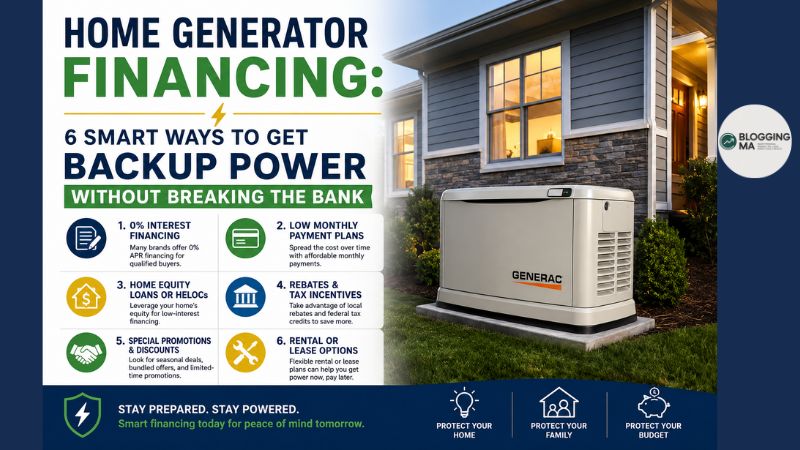
A power outage lasting a few hours is an inconvenience. One lasting several days — during a winter storm, a hurricane, or a major grid failure — is a genuine emergency. A flooded basement because the sump pump lost power, a freezer full of spoiled food, a home that drops to dangerous temperatures overnight — these are not hypothetical scenarios. They happen to thousands of homeowners every year. A whole-home standby generator prevents all of it. The problem is the price tag.
Most U.S. home standby generators can be financed for as low as $109 per month, with total installation costs ranging between $8,000 and $16,000 inclusive of the generator, transfer switch, materials, and installation. That is a significant investment — one that most households cannot pay out of pocket without planning. Generator financing exists to make backup power accessible now rather than after the next outage has already caused damage. This guide covers every generator financing option available in 2026, what each one costs, how to qualify, and how to choose the option that makes the most financial sense for your situation.
[CALLOUT BOX — WHAT YOU WILL LEARN]
- How much a whole-home generator actually costs in 2026
- Every generator financing option clearly explained
- How Generac’s official financing program works
- What PACE financing is and why it matters for homeowners
- What credit score you need for each financing path
- The one calculation to run before signing any generator financing agreement
Read Also: Waters Cryptopronetworkcom: Everything You Need to Know
How Much Does a Generator Cost — And Why Financing Makes Sense
Before comparing generator financing options, you need to know what you are actually financing. Generator costs vary significantly based on the type of unit, its power output, the brand, and the complexity of the installation.
Standby generators are permanent installations that automatically provide power during an outage. They are designed to power an entire home and can run on natural gas or propane. In terms of power output, 7 to 10 kW generators suitable for small homes typically cost between $2,000 and $3,500. Generators producing 20 to 22 kW for medium to large homes can cost between $4,000 and $5,500. Units producing 30 to 50 kW for very large homes can range from $6,000 to $15,000.
When you add professional installation — which includes site preparation, electrical work, an automatic transfer switch, fuel line connections, and permits — the total project cost climbs considerably. The total cost for a professionally installed Generac home standby generator typically ranges from $8,000 to $16,000, with the average investment being around $13,000. This price includes the generator itself, the automatic transfer switch, and all the labor for site prep, electrical work, and fuel connections.
Read Also: Complete Guide to Finance Cryptopronetworkcom
These numbers explain why generator financing is so common. A $13,000 whole-home installation is not money most households have sitting available without disrupting their emergency fund or other financial goals. Financing turns that lump sum into a manageable monthly payment — and in most cases, that monthly payment is less than what a single major power outage would cost in spoiled food, flooding damage, and emergency repairs.
Studies show that a standby generator can increase your home’s resale value by as much as 3% to 5%. On a $350,000 home, that is a $10,500 to $17,500 increase in property value — often more than the cost of the generator itself. Understanding the full financial picture — not just the upfront cost — is what makes generator financing a rational decision rather than simply a convenient one.
6 Generator Financing Options — Explained Clearly
1. Manufacturer Financing — Generac and Other Brands
The most direct generator financing path runs through the manufacturer itself. Most U.S. home standby generators can be financed for as low as $109 per month, with total costs ranging between $8,000 and $16,000, inclusive of the Generac Generator, System Equipment and Materials, and Installation.
Generac — the largest standby generator manufacturer in North America — offers financing directly through authorized dealers. The application happens at the point of sale, approval is typically fast, and the financing covers the full project cost including installation. Promotional periods with low or 0% APR are sometimes available on qualifying purchases through Generac’s dealer network.
Other major generator brands including Kohler, Cummins, and Briggs and Stratton offer similar manufacturer-backed financing programs through their authorized dealer networks. The key question with any manufacturer financing — as with all promotional offers — is whether the promotional rate is true 0% APR or deferred interest. Always confirm which structure applies before accepting any manufacturer financing offer.
ReadALso: Everything You Need to Know About NordicTrack Financing Company
2. Personal Loans
A personal loan from a bank, credit union, or online lender is one of the cleanest generator financing options available. You borrow a fixed amount, receive funds quickly, and repay in fixed monthly installments over a set term — typically 24 to 60 months. No deferred interest risk, no promotional period traps, and your rate is locked from day one.
Generator financing typically ranges from 4.99% to 12.99% APR. For borrowers with good credit — scores of 690 or above — personal loan rates from competitive online lenders fall comfortably within that range. On a $10,000 generator loan at 7.5% APR over 48 months, your monthly payment is approximately $242 and total interest paid is around $1,616. That same loan at 12% APR costs $263 per month and $2,624 in total interest — a difference of over $1,000 for the same generator.
Pre-qualifying with two or three online lenders before your installer appointment takes about 15 minutes and gives you a benchmark rate to compare against any financing the installer offers. According to the Consumer Financial Protection Bureau, personal loans are among the most transparent financing products available because the full cost is disclosed upfront — no surprise interest charges at the end of a promotional period.
Read Also: Everything You Need to Know About Gap Financing
3. Home Equity Loan or HELOC
For homeowners with significant equity, a home equity loan or home equity line of credit typically offers the lowest available interest rate for generator financing. Because the loan is secured by your property, lenders can offer rates between 7% and 8.5% for qualified borrowers — competitive with personal loans but sometimes lower for larger projects.
A home equity loan provides a lump sum at a fixed rate — ideal for a single generator installation with a defined cost. A HELOC provides a revolving credit line — better suited if you are combining the generator with other home improvements like roof replacement or gutter installation, where total costs accumulate over multiple projects.
The trade-off is processing time — home equity applications typically take four to six weeks — and risk, since your home secures the debt. For urgent generator installation before a storm season, a personal loan’s faster funding often outweighs the rate advantage of a home equity product.
4. PACE Financing — Property Assessed Clean Energy
PACE financing is a government-backed program that allows homeowners to fund energy-related home improvements — including backup generators in eligible states — through a special assessment on their property, repaid over time through their property tax bill.
In Florida, the Property Assessed Clean Energy (PACE) program allows homeowners to finance installation with no upfront payments, with repayment made through property taxes. Similar C-PACE and R-PACE programs exist in more than 35 states. Repayment terms can extend to 10 to 25 years, which significantly lowers the annual cost compared to a short-term personal loan.
The approval process for PACE financing is based on property equity rather than personal credit score — making it accessible to homeowners who may not qualify for competitive personal loan rates. The limitation is geographic — PACE availability varies significantly by state, and not all generator installations qualify under every state’s program. Check your state’s specific PACE program eligibility before pursuing this path.
Read Also: Everything You Need to Know About Gap Financing
5. Generator Lease Programs
What makes a leasing program so appealing is its flexibility. It gives you a clear path to owning a high-quality generator without the immediate financial strain of buying it outright. The low upfront cost and fixed monthly payments make it easier to fit into your household budget.
Generator lease programs are offered by select dealers and manufacturers, typically structured similarly to equipment leases. You make monthly payments for a set period — commonly 36 to 60 months — and may have the option to purchase the generator outright at the end of the lease term. Lease payments are typically lower than loan payments for the same equipment because you are not paying to own the asset during the lease period.
The trade-off is that you do not build equity in the generator during the lease term, and if you purchase the unit at lease end, the total cost often exceeds what a direct loan would have cost. Leasing works best for homeowners who want the lowest possible monthly payment and are comfortable with the end-of-lease purchase decision being made later.
Read Also: Everything You Need to Know About Gutter Financing
6. Credit Cards
A credit card can finance a generator purchase, but only makes financial sense in specific circumstances. If you have access to a card offering a true 0% introductory APR for 12 to 18 months and can clear the balance before the promotional period ends, a credit card provides free short-term financing with no application beyond the initial card approval.
Outside of a 0% introductory offer, standard credit card APRs averaging above 24% make them the most expensive generator financing option. Never carry a generator balance on a high-rate card for more than one or two billing cycles unless you have exhausted all other options.
Generator Financing Cost Comparison Table
| Financing Option | Typical APR | $10,000 Monthly Payment | Total Interest | Best For |
| True 0% manufacturer / promo | 0% | $208/month for 48 months | $0 | Buyers who pay in full before deadline |
| Personal loan — good credit | 5% to 8% | $230 to $245/month | $1,040 to $1,760 | Clean financing, no traps |
| Home equity loan | 7% to 8.5% | $232 to $238/month | $1,136 to $1,424 | Homeowners with equity |
| PACE financing | 6% to 9% | $111/month for 10 years | $3,320 to $6,800 | Low monthly payment priority |
| Generator lease | Variable | Lowest monthly | Varies — may cost more total | Lowest upfront cost |
| Credit card standard | 24%+ | $316+/month | $5,184+ | Emergency use only |
A Real Example: How Lisa Financed a $12,000 Generator Installation
Lisa, 45, a nurse earning $4,600 per month, experienced a four-day power outage during a winter storm that caused $1,800 in damage — a burst pipe, spoiled food, and an emergency plumber call. She decided a standby generator was no longer optional.
Her installation quote: $12,000 total for a 20kW Generac unit with full installation.
Options she compared:
- Generac dealer financing: 9.9% APR, 60 months — monthly payment $255, total interest $3,300
- Personal loan from credit union: 6.9% APR, 60 months — monthly payment $237, total interest $2,220
- Home equity loan: 7.8% APR, 84 months — monthly payment $185, total interest $3,540
What she did: She chose the credit union personal loan at 6.9% APR. Monthly payment of $237 fit comfortably within her budget — representing about 5% of her monthly take-home pay. Total interest of $2,220 was $1,080 less than the dealer financing option.
Result: Generator installed before the next winter season. The following year, a three-day outage caused zero damage — the generator kicked in automatically within seconds of the power failure. Lisa calculated that she had already avoided more in potential damage costs than she paid in total loan interest.
What Credit Score Do You Need for Generator Financing?
| Financing Option | Minimum Score | Notes |
| Personal loan — best rates | 720+ | APR from 5% to 7% |
| Personal loan — good rates | 680 to 719 | APR from 7% to 10% |
| Personal loan — fair rates | 640 to 679 | APR from 10% to 15% |
| Manufacturer financing | 620 to 640 estimated | Varies by lender — soft pre-check available |
| PACE financing | Property-based | Credit score secondary — equity matters more |
| Generator lease | 580+ | More flexible approval |
| BNPL pay-in-4 | 550+ | Soft check only — for smaller portable units |
If your score is below 640, PACE financing and generator lease programs are the most accessible paths to a whole-home standby unit. For portable generators priced under $2,000, BNPL pay-in-4 options from Affirm or Klarna provide accessible financing with soft credit checks only.
Improving your credit score before applying — by paying down existing balances and avoiding new credit applications for 60 to 90 days — can move you into a meaningfully better rate tier. The financial habits that build credit are the same ones covered in our guides on best daily saving habits and how to save money from salary.
Common Mistakes Homeowners Make With Generator Financing
| Mistake | Why It Fails | What To Do Instead |
| Accepting dealer financing without comparing outside lenders | Dealer financing is convenient but often not the cheapest option | Pre-qualify with one outside lender before your dealer appointment — takes 15 minutes |
| Focusing only on monthly payment | Lower monthly on a longer term often costs $1,000 to $2,000 more in total interest | Calculate total repayment across all term options before choosing |
| Assuming all 0% offers are the same | Deferred interest triggers full accrued interest if balance not cleared by deadline | Ask specifically: “Is this true 0% APR or deferred interest?” |
| Delaying installation to avoid financing | Power outage damage typically costs more than generator financing interest | Finance the installation — the cost of waiting often exceeds the cost of borrowing |
| Oversizing the generator to maximize coverage | Larger unit means larger loan — not all appliances need to run simultaneously | Get a professional load assessment to size the generator correctly for your actual needs |
[CALLOUT BOX — PRO TIP] Before signing any generator financing agreement, calculate this number: divide your estimated annual electricity outage damage risk by 12. If your home’s risk of outage-related damage — flooded basement, burst pipes, food spoilage — exceeds your monthly generator loan payment, the financing pays for itself in protection value alone. For most homeowners in outage-prone areas, this calculation makes the decision very clear.
[CALLOUT BOX — WARNING] Generator installation requires permits, electrical work, and gas line connections — all of which must be done by licensed professionals. Never finance a generator installation with a contractor who offers to skip the permit process to reduce costs. Unpermitted installations void manufacturer warranties, create homeowners insurance complications, and can cause safety hazards that cost far more than the permit fees saved.
Is Generator Financing Worth It?
The question of whether generator financing is worth it has a clear answer for most homeowners in areas prone to power outages — yes, decisively.
Financing can be a fantastic tool that makes getting a generator much more accessible. Instead of paying a large sum upfront, you can break the cost into manageable monthly payments that fit your budget. This allows you to get the protection and peace of mind you need for your family right away, without having to drain your savings.
The math supports this clearly. A $12,000 generator financed at 7% APR over 60 months costs $2,376 in total interest. A single major power outage causing basement flooding, burst pipes, and spoiled food can cost $5,000 to $15,000 in repairs and replacements. The financing cost is a fraction of the risk it eliminates. For homeowners in hurricane zones, winter storm corridors, or areas with aging grid infrastructure, that risk is not theoretical — it is a matter of when, not if.
Generator financing makes the most sense when the monthly payment fits comfortably within your budget — generally no more than 5% to 8% of monthly take-home pay — and you choose a financing option with transparent terms and no deferred interest traps.
If you are also building savings alongside a home improvement loan, our 30-day money saving challenge and how to start saving from zero give you the practical framework to manage both simultaneously — a monthly loan payment and a growing financial cushion — without one undermining the other.
Frequently Asked Questions About Generator Financing
What is the best generator financing option for most homeowners? For homeowners with good credit, a personal loan from a credit union or competitive online lender typically offers the best combination of transparent terms, low rates, and fast funding. APRs between 5% and 10% are available for scores above 680, with funding in one to three business days. For homeowners who qualify for a true 0% manufacturer offer and can pay the balance in full before the deadline, that option costs even less in total.
How much does it cost per month to finance a generator? Most U.S. home standby generators can be financed for as low as $109 per month. More typical monthly payments for a whole-home installation range from $180 to $300 per month depending on the loan amount, interest rate, and term chosen. A $10,000 loan at 7% APR over 60 months produces a monthly payment of approximately $198.
Can I finance a generator with bad credit? Yes, through PACE financing programs available in many states and through generator lease programs from select dealers. PACE approval is based on property equity rather than personal credit score. Lease programs have more flexible approval standards than conventional loans. Both options provide paths to generator installation without requiring a strong credit history.
Does financing a generator affect my credit score? Pre-qualifying with most online lenders uses a soft credit check — no impact to your score. Submitting a full loan application triggers a hard inquiry, which may temporarily lower your score by two to five points. Making on-time monthly payments on a generator loan builds positive payment history and can improve your credit score over the loan term.
What size generator do I need and does it affect financing? Generator sizing depends on your home’s square footage, which appliances you need to power, and your fuel source availability. A professional load assessment from a licensed installer is the most reliable way to determine the right size. Sizing matters for financing because a correctly sized generator costs less than an oversized one — which means a smaller loan, less interest, and a lower monthly payment. Never finance more generator than your actual power needs require.
Protect Your Home Before the Next Outage — Finance It the Smart Way
A whole-home standby generator is one of the few home improvements that pays for itself before it is ever fully paid off. Every power outage it handles — every sump pump it keeps running, every furnace it powers through a winter storm, every freezer full of food it saves — delivers real financial value that offsets the cost of financing it.
The generator financing options available in 2026 are accessible across a wide range of credit profiles and budgets. Get two or three quotes from licensed installers. Pre-qualify with one outside lender before your dealer appointment. Ask whether any 0% offer involves deferred interest. Calculate total repayment — not just monthly payment — across all options.
That process takes about an hour and can save you $1,000 to $2,000 on your total generator financing cost. More importantly, it means your home is protected before the next outage — and that protection starts working the moment the installation is complete.