

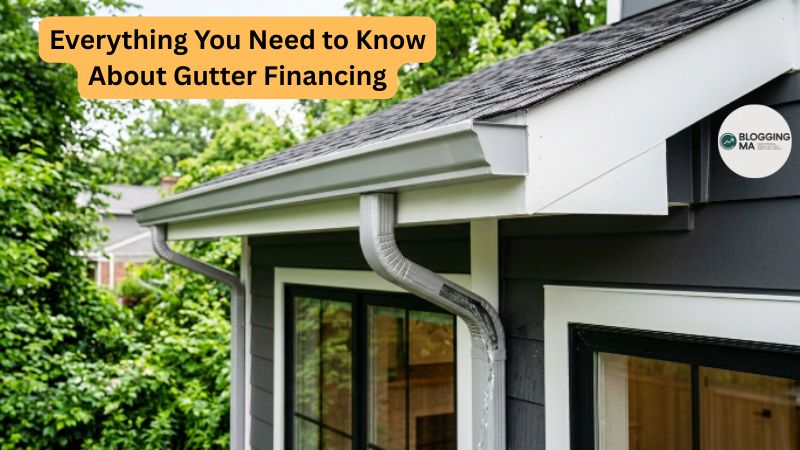
Water damage is one of the most expensive home repairs a homeowner can face — and most of it starts with gutters that failed quietly over months or years before anyone noticed. Foundation cracks, basement flooding, rotted fascia boards, and stained siding are all downstream consequences of a gutter system that stopped doing its job. The problem is that replacing gutters costs anywhere from $2,300 to $6,400 for a typical home — and that bill tends to arrive exactly when no one has budgeted for it.
Gutter financing exists to close that gap. Whether you need a full gutter replacement, seamless gutters with guards installed, or a complete drainage system overhaul, spreading the cost over time means the repair happens now — before water damage compounds into something far more expensive. This guide covers every gutter financing option available today, what each one costs, how to qualify, and how to avoid the common traps that make contractor financing more expensive than it needs to be.
[CALLOUT BOX — WHAT YOU WILL LEARN]
- How much gutters actually cost in 2026 — by material and home size
- Every gutter financing option explained clearly
- How contractor 0% offers work — and when they become a trap
- Which financing option costs the least in total interest
- What credit score you need for each option
- The one question to ask every contractor before signing a financing agreement
How Much Do Gutters Cost — And Why Financing Often Makes Sense
Before comparing gutter financing options, you need to know what you are actually paying for. Gutter costs vary significantly based on material type, whether the system is seamless or sectional, your home’s size, and local labor rates.
According to data from This Old House, gutter installation costs $12 to $62 per linear foot of material, or between $2,303 and $12,067 to install 200 linear feet of gutters for a 2,000 square foot home. The national average cost to replace gutters ranges from $2,834 to $5,170 in 2025 and 2026. Here is what different gutter materials typically cost per linear foot:
- Vinyl gutters: $3 to $7 per linear foot — cheapest option but less durable in harsh weather
- Aluminum gutters: $3 to $15 per linear foot — best balance of cost and durability, most popular choice
- Steel gutters: $5 to $20 per linear foot — stronger but heavier and prone to rust over time
- Copper gutters: $25 to $40 per linear foot — premium option, lasts 50+ years, significant upfront cost
For a typical 2,000 square foot home needing 200 linear feet of seamless aluminum gutters with professional installation, expect a total project cost of $2,400 to $4,500. Add gutter guards and the number rises to $3,000 to $6,800 depending on the guard system chosen.
These are not emergency numbers for most households — they are planned home maintenance costs that often arrive unplanned. Gutter financing turns a budget-disrupting expense into a predictable monthly payment, and in many cases the monthly payment is lower than the first month of water damage repair costs that failed gutters would eventually cause. Protecting your home now is almost always cheaper than repairing it later — and the same financial principle applies to every major home expense, as covered in our guide on everything you need to know about roof financing options.
6 Gutter Financing Options — Explained Clearly
1. Contractor-Offered Financing
Most professional gutter installation companies offer financing directly through their checkout or proposal process — either through their own payment plans or via third-party lenders they have partnered with. Companies like LeafFilter and Leafguard, two of the largest gutter guard installers in North America, work directly with banks so homeowners can finance their installations at the point of sale.
The appeal is convenience. You get your quote, choose your system, and arrange financing all in one conversation — no separate lender applications, no waiting for approval from an outside institution. Many contractors offer 0% APR promotional financing for 12 to 24 months on qualifying purchases, which makes the monthly payment very manageable on a $3,000 to $5,000 project.
Read Also: Everything You Need to Know About Gap Financing
The catch — and it is an important one — is how that 0% offer actually works. Many contractor financing programs use deferred interest rather than true 0% APR. With deferred interest, interest accrues from day one at the standard rate — often 19.99% to 26.99% APR — but does not appear on your statement during the promotional period. If you carry any balance past the promotional deadline, all the accrued interest hits your account at once. On a $4,000 gutter installation with deferred interest at 24.99% APR, carrying a $500 balance past month 12 could trigger $1,000 or more in surprise interest charges.
Always ask this exact question before accepting contractor financing: “Is this true 0% APR or deferred interest?” The answer changes the total cost of your gutter system significantly.
2. Personal Loans
A personal loan from a bank, credit union, or online lender is one of the cleanest gutter financing options available. You borrow a fixed amount, receive funds quickly — often within one to three business days — and repay in fixed monthly installments over a set term, typically 24 to 60 months.
Personal loans carry no deferred interest risk. Your rate is fixed from day one, your monthly payment never changes, and there are no promotional period traps to watch for. For borrowers with good credit — scores of 690 or above — personal loan APRs from competitive online lenders run between 6% and 12%, which is often lower than contractor financing outside of true 0% promotional periods.
On a $4,000 gutter replacement financed at 8.5% APR over 36 months, your monthly payment is approximately $127 and total interest paid is around $556. That same project at 19.99% APR — common for contractor financing outside promotional periods — costs $149 per month and $1,364 in total interest over the same term. The difference is $808 for the exact same gutters. Pre-qualifying with two or three lenders before your contractor appointment takes about 15 minutes and costs you nothing — it also gives you a benchmark to compare against any financing the contractor offers.
Read Also: Everything You Need to Know About Commercial Solar Financing
According to the Consumer Financial Protection Bureau, personal loans are among the most transparent financing products available to consumers because the full cost is disclosed upfront — no promotional periods, no deferred interest, no variable rate surprises.
3. Home Equity Loan or HELOC
If you have built significant equity in your home, a home equity loan or home equity line of credit (HELOC) may offer the lowest available interest rate for gutter financing. Home equity products are secured by your property, which allows lenders to offer rates typically between 7% and 8.5% for qualified borrowers — lower than most unsecured personal loans and far lower than contractor financing.
A home equity loan provides a lump sum at a fixed rate — ideal for a single gutter project with a defined cost. A HELOC provides a revolving credit line that you can draw from as needed — better suited if you are combining gutter replacement with other home improvement projects.
The trade-off is processing time and risk. Home equity applications take four to six weeks to process — making them impractical for urgent repairs. And because your home secures the debt, defaulting puts your property at risk. For a $3,000 to $6,000 gutter project, the rate advantage over a personal loan is real but modest. Home equity financing makes more sense when combining gutter replacement with a larger renovation project — roofing, siding, or major structural work — where the total project cost justifies the application effort and processing time.
4. FHA Title 1 Home Improvement Loan
The Federal Housing Administration’s Title 1 loan program provides government-backed financing specifically for home improvements, including gutter replacement and drainage system upgrades. Loans up to $7,500 are unsecured — no collateral required. This covers the full cost of most gutter projects.
FHA Title 1 loans are available through FHA-approved lenders and require lower credit scores than conventional personal loans, making them accessible to homeowners who may not qualify for competitive personal loan rates. Fixed rates and predictable payments make budgeting straightforward. You can find FHA-approved lenders through the US Department of Housing and Urban Development.
This option is particularly worth exploring if your credit score is between 580 and 660 — a range where personal loan rates become less competitive but FHA Title 1 remains accessible at reasonable terms.
5. Credit Cards
A standard credit card can finance a gutter project, but only makes financial sense in two specific situations. First, if you have access to a card with a true 0% introductory purchase APR — typically offered for 12 to 18 months on new accounts — and you can clear the balance before the promotional period ends, a credit card provides effectively free financing with no application beyond the initial card approval.
Second, for smaller gutter repairs under $1,500 that you can pay off within 30 to 60 days, a standard credit card with cash back rewards turns a necessary home expense into points or cash back at no interest cost.
Outside these two scenarios, standard credit card APRs averaging above 24% make them the most expensive gutter financing option. Never carry a gutter balance on a high-rate card for more than one billing cycle unless you have exhausted all other options.
6. Buy Now Pay Later Platforms
BNPL platforms like Affirm and Klarna are increasingly available through home improvement contractors and material suppliers. Pay-in-4 options split the total cost into four equal payments every two weeks at 0% interest — making them effectively free financing for balances under $2,000 payable within eight weeks.
For larger gutter projects, Affirm offers longer-term monthly payment plans at APRs ranging from 0% to 36% depending on your credit profile. These plans show the full total cost including any interest before you confirm — making them more transparent than many contractor financing arrangements. BNPL approval uses soft credit checks only, meaning your credit score is not affected by the application.
Gutter Financing Cost Comparison Table
| Financing Option | Typical APR | $4,000 Monthly Payment | Total Interest | Best For |
| True 0% contractor / BNPL | 0% | $111 for 36 months | $0 | Buyers who pay off in promotional period |
| Personal loan — good credit | 6% to 9% | $124 per month / 36 months | $464 to $644 | Clean financing, no traps |
| FHA Title 1 loan | 7% to 10% | $125 to $130 per month | $500 to $680 | Lower credit score buyers |
| Home equity loan | 7% to 8.5% | $124 to $127 per month | $464 to $572 | Homeowners with equity, larger projects |
| Contractor deferred interest | 19.99% to 26.99% | $150 to $165 per month | $1,400 to $1,940 | Avoid unless paid in full before deadline |
| Credit card (standard) | 24%+ | $166+ per month | $2,000+ | Emergency use only |
A Real Example: How David Avoided a $1,200 Financing Mistake
David, 47, a school principal earning $4,200 per month, needed seamless aluminum gutters with gutter guards installed on his home. Three contractor quotes came back at $3,800, $4,100, and $4,400 for similar systems.
He chose the $3,800 quote. The contractor offered 18-month financing at 0% — but when David asked specifically whether it was true 0% APR or deferred interest, the contractor confirmed it was deferred interest at 21.99% APR standard rate.
What David did instead: He pre-qualified with two online lenders in 12 minutes. One offered 9.1% APR over 36 months — a monthly payment of $121 and total interest of $556.
Comparison:
- Contractor deferred interest (if $400 balance carried past month 18): estimated $800 to $1,100 in surprise interest charges
- Personal loan at 9.1% APR: $556 total interest over 36 months — known upfront, no surprises
Result: David financed through the personal lender, paid $556 in total interest, and got the same gutters from the same contractor. The 12 minutes of pre-qualification saved him between $244 and $544 compared to the deferred interest trap — and gave him complete certainty about his total cost from day one.
What Credit Score Do You Need for Gutter Financing?
| Financing Option | Minimum Score | Notes |
| Personal loan — best rates | 720+ | APRs from 6% to 8% |
| Personal loan — good rates | 680 to 719 | APRs from 8% to 12% |
| Personal loan — fair rates | 640 to 679 | APRs from 12% to 18% |
| FHA Title 1 | 580+ | Government-backed — more accessible |
| Contractor financing | 620 to 640 estimated | Varies by lender |
| BNPL pay-in-4 | 550+ | Soft check only |
| Home equity | 640+ | Based on equity, not just credit score |
If your score is below 640, FHA Title 1 and BNPL pay-in-4 options are your most accessible paths. Spending two to three months paying down existing balances before applying can move your score enough to unlock significantly better personal loan rates — saving more in interest than the delay costs. The fundamentals that build credit — consistent on-time payments and reduced debt utilization — are the same habits covered in our guides on how to save money from salary and best daily saving habits.
Common Mistakes Homeowners Make With Gutter Financing
| Mistake | Why It Fails | What To Do Instead |
| Accepting contractor financing without asking about deferred interest | Deferred interest triggers full accrued interest if balance not cleared by deadline | Always ask: “Is this true 0% APR or deferred interest?” before signing |
| Choosing the cheapest quote without comparing financing terms | A lower project price with worse financing can cost more in total | Calculate total repayment across all options — not just project cost |
| Delaying gutter replacement to avoid financing | Water damage costs $5,000 to $15,000 to repair — far more than the gutter project | Finance the repair now — the cost of waiting almost always exceeds the cost of financing |
| Focusing only on monthly payment | A lower monthly payment on a longer term often costs $500 to $1,000 more in total interest | Calculate total interest across term lengths before choosing |
| Not getting multiple contractor quotes | Gutter quotes vary by 20% to 40% for comparable work | Get three quotes — negotiate the project cost before discussing financing |
[CALLOUT BOX — PRO TIP] Before accepting any contractor financing offer, spend 15 minutes pre-qualifying with one online personal lender. Most offer soft credit checks — no impact to your score. Compare their rate and total cost against the contractor’s offer. If the personal loan is cheaper in total, use it and pay the contractor directly as a cash customer. This single step saves most homeowners $400 to $1,000 on a mid-range gutter project.
[CALLOUT BOX — WARNING] Never assume a contractor’s “0% financing” offer means no interest. Many programs — including those offered by major gutter companies — use deferred interest, where interest accrues from day one at rates of 19.99% to 26.99%. If you carry any balance past the promotional deadline, all that accrued interest hits your account at once. Ask for the full terms in writing before you agree to anything.
Is Gutter Financing Worth It?
The short answer is yes — when the alternative is delaying a repair that is already causing or about to cause water damage.
Professional gutter installation prevents $5,000 to $15,000 in foundation damage, $2,000 to $5,000 in fascia replacement costs, and $3,000 to $10,000 in interior water damage. A $4,000 gutter project financed at 9% APR over 36 months costs $556 in total interest. The cost of that interest is trivial compared to the damage a failing gutter system will cause if replacement is delayed by 12 to 24 months.
Gutter financing makes the most sense when the gutters genuinely need replacement, the monthly payment fits your budget without displacing savings or essential expenses, and you choose a financing option with transparent terms and no deferred interest traps.
If you are also working on building financial reserves alongside a home improvement expense, our 30-day money saving challenge and how to start saving from zero guide give you the practical framework to manage both simultaneously — a loan payment and a growing savings account — without one undermining the other.
Frequently Asked Questions About Gutter Financing
What is the best gutter financing option for most homeowners? For homeowners with good credit, a personal loan from a competitive online lender offers the best combination of transparent terms, competitive rates, and fast funding. APRs between 6% and 12% are available for scores above 680, with funding in one to three business days. For buyers who qualify for a true 0% contractor or BNPL offer and can pay off the balance before the deadline, that option costs even less in total.
Can I finance gutters with bad credit? Yes. FHA Title 1 home improvement loans are accessible to borrowers with scores as low as 580 and provide unsecured financing up to $7,500 — enough to cover most gutter projects. BNPL pay-in-4 options also have low approval thresholds and use soft credit checks. Both options provide accessible financing without requiring home equity as collateral.
How much does it cost to finance a $4,000 gutter project? At 8.5% APR over 36 months, a $4,000 gutter loan costs approximately $127 per month and $556 in total interest — a total repayment of $4,556. At a deferred interest rate of 21.99% (common with contractor financing), the same project costs around $150 per month and $1,400 in total interest if carried the full term. The difference between choosing the right financing option is over $844 for the identical gutter installation.
Does gutter financing affect my credit score? Pre-qualifying with most online lenders uses a soft credit check that does not affect your score. Submitting a full loan application triggers a hard inquiry, which may temporarily lower your score by two to five points. BNPL pay-in-4 options typically use soft checks only. Making on-time monthly payments on a financed gutter project can improve your credit score over time by building a positive payment history.
How long does gutter financing take to get approved? Personal loan pre-qualification takes about 10 to 15 minutes online and provides an estimated rate with no impact to your credit score. Full approval and funding typically takes one to three business days. Contractor financing is usually approved at the point of sale — within minutes. FHA Title 1 applications through approved lenders take longer — typically one to two weeks for full processing.
Protect Your Home Now — Finance It the Smart Way
Gutters are not a glamorous home improvement. They are a functional necessity that most homeowners ignore until water damage makes them impossible to overlook any longer. Gutter financing removes the financial barrier to doing the right thing at the right time — before a $4,000 repair becomes a $15,000 foundation problem.
The financing options are clear, the costs are manageable, and the alternative — continued water damage — is far more expensive than any reasonable financing arrangement. Get three contractor quotes. Ask whether any 0% offer involves deferred interest. Pre-qualify with one personal lender for comparison. Choose the option with the lowest total cost that fits your monthly budget comfortably.
That sequence takes about an hour and can save you $500 to $1,000 on your total gutter financing cost. More importantly, it means your home is protected before the next heavy rain — and that is worth more than any interest rate calculation.