


Most people searching for Genesis credit financing fall into one of two situations. Either they have been turned down for a traditional credit card and are looking for a way in, or a retailer just offered them a “Genesis Credit” option at checkout and they want to know what they are agreeing to before they sign. Both are smart reasons to do your research first — because Genesis credit financing is one of those products that genuinely helps some people and genuinely costs others far more than they expected.
Here is the full picture. Genesis credit financing is a product of Concora Credit, formerly known as Genesis Financial Solutions — a company founded in 2001 that describes itself as the nation’s leading provider of credit programs for non-prime consumers. In plain terms, that means they serve people with bad to fair credit scores, typically FICO scores between 300 and 689, who cannot yet qualify for mainstream credit cards. This guide covers exactly how Genesis credit financing works, what it actually costs, who it makes sense for, and what your alternatives are if you decide it is not the right fit.
What Is Genesis Credit Financing?
Genesis credit financing refers to two related but distinct products offered under the Concora Credit umbrella. The first is a set of general-purpose unsecured Mastercards — including the Milestone, Indigo, and Destiny cards — designed for consumers with damaged or limited credit histories. The second is a point-of-sale retail financing program called Genesis Credit, which partners with merchants to offer in-store and online financing to non-prime consumers who may be declined for standard retail credit.
Genesis is the nation’s leading provider of private-label credit programs for non-prime consumers, originating private-label credit cards through point-of-sale partnerships with top merchants, and originating non-prime Mastercard accounts through its Indigo and Milestone brands. What this means for everyday consumers is that whether you are applying for a credit card online or being offered a financing option at a furniture store or jewelry retailer, there is a good chance Concora Credit is the company processing your application behind the scenes.
The core appeal of Genesis credit financing is accessibility. These cards may be easier to get than other credit cards, and because they are unsecured, they do not require an upfront deposit. They also report to all three major credit bureaus, so responsible use — such as paying on time — can help your credit scores. For someone who has been turned down everywhere else and needs to start building a credit history, that combination of no deposit and credit bureau reporting has genuine value.
The Real Cost of Genesis Credit Financing
This is the section most people skip, and skipping it is exactly how they end up surprised. Genesis credit financing is not expensive in a hidden way — the fees are disclosed in the terms. The problem is that most people do not read the terms carefully before applying, and the fees are structured in a way that reduces your purchasing power from the very first day.
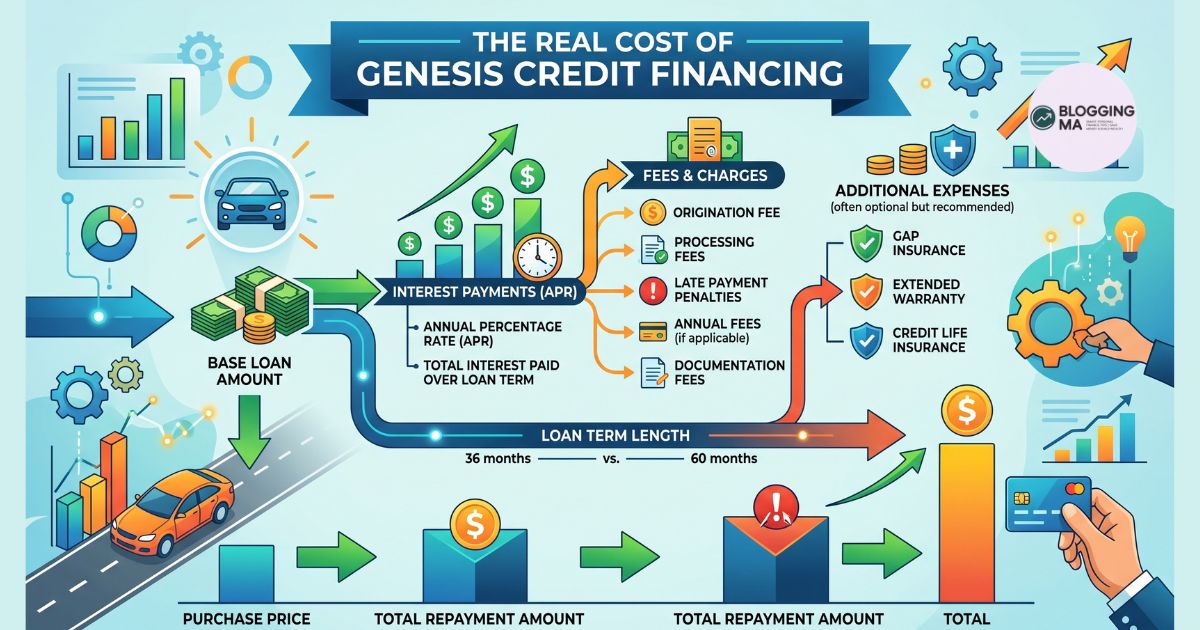
You will pay $573 in fees over three years even if you never miss a payment or exceed your credit limit. That is before counting interest charges on any carried balance.
Here is how that breaks down in practice. Annual fees for a Destiny credit card are $175 the first year and $49 after. In addition to an annual fee, the card charges a monthly fee, which can add up to $150 a year. The Indigo credit card has similar terms — its annual fee is $175 the first year and $49 after that, and it also charges $12.50 as a monthly fee.
There is another cost that catches people completely off guard. Your annual fee is charged immediately upon account opening, reducing your available credit before you make your first purchase. A $300 limit becomes $125 in available credit after the annual fee posts. So if you are approved for a $300 credit limit and there is a $175 annual fee, you only have $125 to actually spend — and that fee hit happens before you buy a single thing.
The interest rates on these cards are also high, sitting in the range that is typical for subprime unsecured credit products. If you carry a balance month to month instead of paying in full, the cost climbs significantly above the fee total above. The honest financial advice here is simple: if you use one of these cards, treat it like a debit card. Spend only what you can pay back in full each month. The fees are unavoidable, but the interest is not.
Read Also: Consultant Finances: Complete Guide to Consultant Finances
Who Should Use Genesis Credit Financing?
Not everyone who applies for a Genesis credit card should. But for a specific type of person in a specific situation, it is a rational choice — and understanding who that person is will help you decide whether it describes you.
Genesis credit financing makes the most sense when you have a FICO score between 300 and 689, you have already been declined for secured cards from major issuers, you cannot come up with a refundable deposit right now (even $200), and your primary goal is to establish a payment history that reports to all three credit bureaus. In that narrow window, a Genesis-affiliated card gives you a legitimate credit-building tool when your other options have run out.
Financial experts recommend treating Genesis credit financing as a temporary credit-building tool. The high fees and APRs require strategic, responsible use. With responsible use, expect potential credit score improvements within 6 to 12 months.
The key word there is temporary. These cards are a stepping stone, not a destination. You use them to establish a payment track record, then graduate to a lower-cost card once your score improves. The problem is that there is no guaranteed upgrade path to a better product within the Genesis/Concora family. That means the exit strategy is on you — you have to actively apply for a better card once your credit improves, rather than waiting for an automatic upgrade.
Genesis credit financing is not a good fit if you already qualify for a secured card from a major issuer like Capital One or Discover, if you tend to carry a balance month to month, or if you are in a financially tight situation where a $175 annual fee hitting your account immediately would cause real hardship.
Read Also: 12 Clever Way to Save Money Fast: Practical Tips That Actually Work
Genesis Credit as a Retail Financing Option
Separate from the general-purpose Mastercards, Genesis Credit also operates as a point-of-sale financing program at select retail merchants. If you have ever been shopping for furniture, jewelry, or home goods and been offered a store financing option after being declined by the primary lender, there is a strong chance Genesis Credit was the “second-look” option presented to you.
The Concora Credit app works with accounts including Kay Jewelers, Zales (GEM Account), Jared The Galleria Of Jewelry, Helzberg Diamonds, Mor Furniture for Less, Ashley Advantage Gold Account, and others. This retail financing arm of the business operates on the same non-prime lending model — giving consumers with lower credit scores access to purchasing power at specific merchants, typically at higher interest rates than prime retail financing offers.
If you are offered Genesis Credit at a retail checkout, read the terms the same way you would for any financing product. Check the APR, check whether there is a deferred interest clause (meaning interest accrues from day one even during a promotional period and hits you in full if you do not pay off the balance in time), and check the monthly payment required to clear the balance before any promotional period ends. These are the details that determine whether retail point-of-sale financing helps or hurts you financially.
For a broader understanding of how retail and in-store financing products work — including the key differences between deferred interest and true 0% offers — our guide on in-house financing covers the mechanics clearly.
How to Apply for Genesis Credit Financing
Applying for a Genesis credit card through Concora Credit is a straightforward online process. You can pre-qualify directly on the Concora Credit consumer page by filling out an application with your personal information, Social Security number, employment details, and monthly income. Individuals with FICO scores between 300 and 689 are typically eligible.
One important detail: the Milestone Rewards Mastercard states there is no impact to your credit score if you are not approved — a hard inquiry will not appear on your credit report if your application is not approved. This is worth confirming on whatever specific card you apply for, since the inquiry policy can vary. For cards where a hard inquiry is standard regardless of outcome, applying for multiple cards in a short window will temporarily lower your score.
Read Also: 30-Day Money Saving Challenge (Step-by-Step Guide to Save Money Fast)
Once approved, your card arrives by mail and you activate it through the Concora Credit app or website. The app allows you to manage payments, view statements, monitor transactions, and set up autopay — which is worth doing immediately to protect against missed payments. A single missed payment on a card like this not only generates a late fee but can also damage the credit score you are trying to build.
Before you apply, spend ten minutes checking your credit report for errors at annualcreditreport.com. Errors on your credit report — wrong account statuses, accounts that are not yours, incorrect balances — are more common than most people realize, and removing them can sometimes improve your score enough to qualify for a less expensive alternative. The Consumer Financial Protection Bureau provides free guidance on how to dispute errors on your credit report, which is always worth doing before applying for any new credit product.
What Credit Score Does Genesis Credit Financing Require?
This is one of the most common questions people search for, and the answer is more forgiving than most people expect. Genesis credit financing through Concora Credit is designed specifically for non-prime consumers, which means the approval threshold is lower than standard credit cards.
Concora Credit provides credit cards for consumers with bad to fair credit, covering FICO scores of 300 to 689. In practice, approval at the lower end of that range (300–580) is possible but typically results in the smallest available credit limits and the highest fees. Applicants with scores in the 620–689 range generally see better starting limits and slightly more favorable terms within the product family.
It is worth noting that Concora Credit does not publish a hard minimum score publicly. Approval decisions also factor in your income stability, existing debt load, and overall application profile — not just your score in isolation. Someone with a 600 score, stable employment, and low existing debt may receive a better offer than someone with a 640 score and multiple delinquent accounts currently on their report.
If your score sits above 670, it is worth checking whether you qualify for a secured card from a mainstream issuer before defaulting to a Genesis-affiliated product. The cost difference over 12 to 24 months can be substantial.
Smarter Alternatives to Genesis Credit Financing
The honest truth is that Genesis credit financing is not the only option for people with bad or fair credit — and for many people, it is not the cheapest path to rebuilding a credit score. These alternatives are worth considering before you commit to the fee structure of a Concora Credit card.
Secured credit cards from major issuers require an upfront deposit — typically $200 — that becomes your credit limit. Capital One’s secured cards and Discover’s secured card both charge $0 in annual fees, report to all three bureaus, and offer a clear upgrade path to an unsecured card once your credit improves. A $200 deposit on Capital One Quicksilver Secured gives you $200 in available credit — not $25 as you would have after the annual fee on a Concora card. If you can scrape together a $200 deposit, a secured card from a major issuer almost always beats a Genesis-affiliated unsecured card on total cost.
Credit unions often offer credit-builder loans and secured credit products at lower rates than either major banks or specialty non-prime lenders. If you have access to a local credit union, it is worth a conversation about their credit-building products before applying for any card.
Becoming an authorized user on a family member’s or trusted friend’s credit card account costs nothing and can improve your credit score by adding their positive payment history to your report. This is not always an option, but when it is, it is one of the fastest ways to improve your score without taking on any new debt or fees.
If your goal is to get your financial foundations strong enough that you never need a subprime credit product again, the habits covered in our best daily saving habits guide and our piece on how to save money from salary are directly relevant — because financial stability and creditworthiness are built from the same underlying behaviors.
How to Use Genesis Credit Financing Without Wrecking Your Finances
If you decide a Genesis credit card is the right tool for your situation right now, the way you use it matters enormously. A product with high fees and high APRs can either help you or hurt you depending entirely on your habits with it.
Follow these rules and the card will do its job:
- Pay your balance in full every single month. Never carry a balance. The interest rate on these cards is high enough that a carried balance quickly makes the card one of the most expensive financial products you own.
- Set up autopay for at least the minimum payment immediately after activation. Log in to your account anytime at concoracredit.myfinanceservice.com to manage payments, view statements, and monitor transactions. This protects you from a missed payment damaging the credit you are trying to build.
- Keep your utilization below 30%. If your credit limit is $500, try not to have more than $150 charged on it at any time. Low utilization relative to your limit is one of the biggest factors in improving your credit score.
- Check your credit score every month using a free monitoring service. This shows you whether the card is doing its job — and when your score has improved enough to qualify for something better.
- Once your score hits 670 or above, apply for a lower-cost card and stop using the Genesis card. Cancel it only after confirming the impact on your credit age, since closing an account can sometimes lower your score temporarily.
Treating this card as a temporary, purposeful tool — rather than a convenient line of credit — is the difference between using Genesis credit financing to build toward something better and paying hundreds of dollars in fees with nothing to show for it.
Frequently Asked Questions About Genesis Credit Financing
What is Genesis credit financing and who is it for? Genesis credit financing refers to unsecured credit cards and retail point-of-sale financing programs offered through Concora Credit, formerly Genesis Financial Solutions. It is designed for consumers with FICO scores between 300 and 689 who have been declined for standard credit products. It offers a way to access credit and build a payment history without requiring an upfront deposit.
What credit score do you need for Genesis credit financing? Genesis credit financing is available to applicants with FICO scores as low as 300, though approval also depends on income, existing debt, and overall financial profile. Better scores within the 580–689 range typically result in higher starting credit limits. Scores above 670 may qualify for less expensive alternatives worth exploring first.
How much does a Genesis credit card actually cost? Total fees over three years can reach $573 or more, even with perfect payment behavior — before any interest charges. The first-year annual fee of $175 is charged immediately upon approval, reducing your available credit from day one. Monthly maintenance fees add another $150 per year on top of the annual fee after year one.
Does Genesis credit financing report to credit bureaus? Yes. All Concora Credit cards — including the Milestone, Indigo, and Destiny Mastercards — report to all three major credit bureaus: Experian, TransUnion, and Equifax. This is what makes them useful as credit-building tools. On-time monthly payments are recorded and contribute positively to your credit history over time.
Is there a better alternative to Genesis credit financing for bad credit? For most people with bad credit, a secured card from a major issuer like Capital One or Discover offers a better value. These cards require a refundable $200 deposit but charge $0 in annual fees, offer upgrade paths, and provide the same credit-building benefit of reporting to all three bureaus. If you can access a $200 deposit, a secured card almost always costs less over 12 to 24 months than a Genesis-affiliated unsecured card.
Making an Informed Decision About Genesis Credit Financing
Genesis credit financing fills a real gap in the market. For someone with a 580 credit score, no deposit available, and a genuine need to start building a credit history, a Concora Credit card may be the most accessible option on the table — and using it responsibly for 12 months can meaningfully improve their score.
But going in without understanding the costs is how people end up frustrated. The fees are real, they are front-loaded, and they reduce your purchasing power from the moment your account opens. The cards do not reward loyalty, do not offer upgrade paths, and do not get cheaper as your credit improves.
Use Genesis credit financing with a clear plan: apply, activate, pay in full every month, monitor your score, and move on to a better product as soon as you qualify. That is the version of this story that ends well. If you are building the financial habits that support that plan — disciplined spending, consistent saving, and a clear budget — our 30-day money saving challenge and guide to passive income ideas for beginners give you the practical framework to get there faster.
The goal is not to need Genesis credit financing forever. The goal is to use it once, use it right, and never need it again.
Looking for more guides on managing credit, financing big purchases, and building financial stability from the ground up? Explore our full library of personal finance articles at Blogging MA.